
Introducing sneaker collectors to digital ownership
Two physical activations designed to answer one question: would traditional collectors take up digital collectibles at all?
- Client
- eBay
- Role
- Senior Digital Marketing Lead, eBay
- Period
- 2022–2023
- Disciplines
- Activation, Research, Community
- Of event attendees claimed a digital collectible
- 56%
- Conversion from email to app download
- 39%
- Influencers engaged across the two activations
- 70+
Overview
Following eBay’s acquisition of KnownOrigin, I was asked to create activations that would bridge eBay’s traditional collector communities and Web3. Sneakers are one of eBay’s most active collector categories, which made them the obvious place to test whether sneakerhead culture and digital ownership had anything to say to each other.
The challenge was real: how do you introduce NFTs to a community with limited exposure to blockchain, without producing something that feels like a gimmick? The answer had to balance novelty against accessibility.
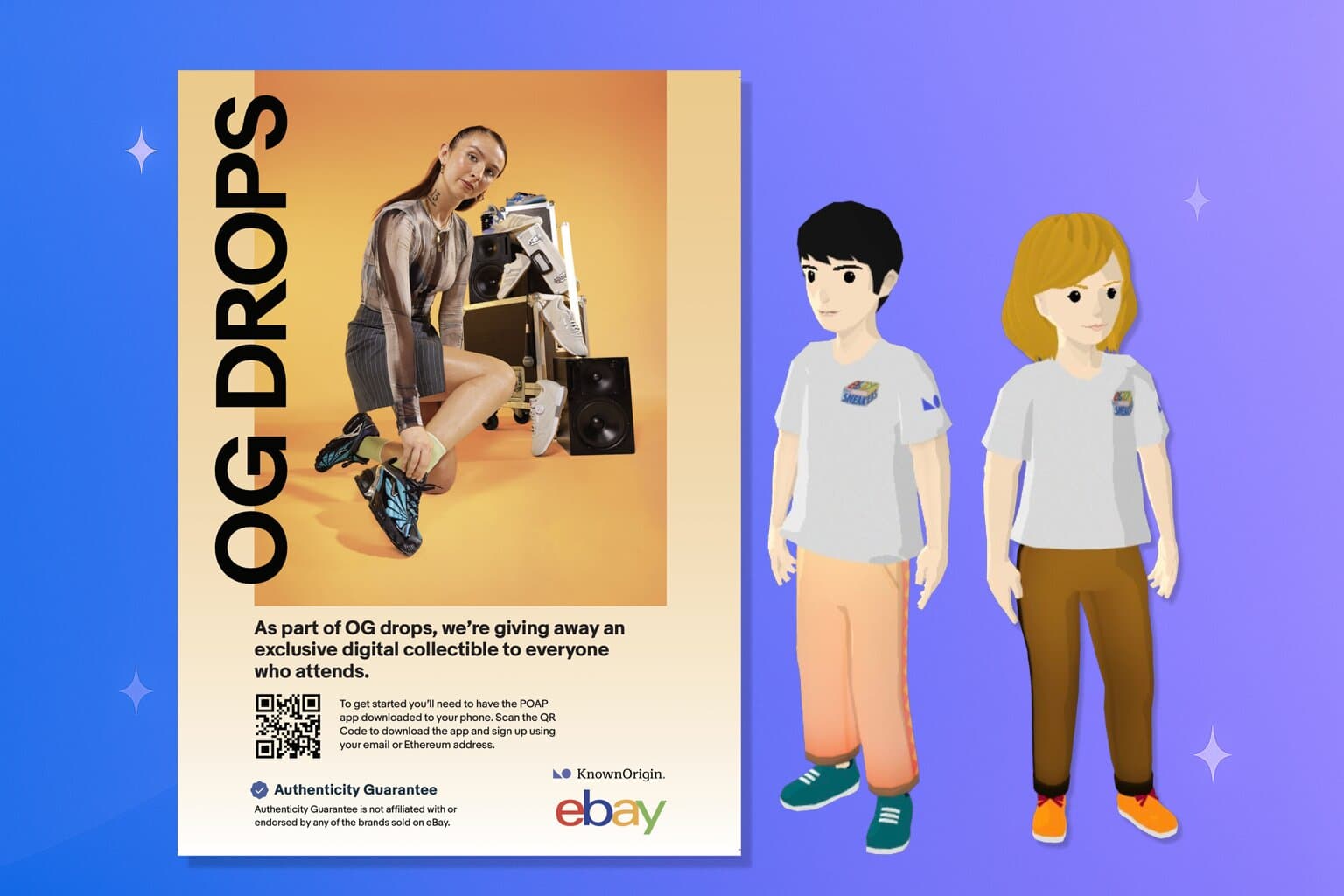
I designed and ran two activations (OG Drops Manchester and Sneaker Con London), introducing digital ownership through POAPs and exclusive digital wearables. By creating low-friction entry points and connecting physical merchandise to digital assets, we achieved strong engagement rates and, more importantly, learned things that were useful well beyond the events themselves.
What was wrong, and what I did about it
The audience was sceptical about NFTs
The sneaker community had limited exposure to NFTs and plenty of scepticism about digital ownership. Traditional collectors valued physical items they could display and trade in person.
Frame them as mementos, not investments
We introduced digital assets through POAPs (proof of attendance), which positioned them as digital mementos rather than speculative assets. That framing landed with a collector mindset, presenting digital items as extensions of a physical collection rather than a replacement for one.
The technical barrier was the real barrier
Most attendees had no crypto wallet and no blockchain knowledge. Asking them to navigate an exchange or set up a wallet would have ended the journey before it started.
Email first, wallets later
We designed an onboarding flow that let people claim a digital asset without cryptocurrency or technical knowledge. It started with an email signup and introduced wallet concepts gradually, which removed the usual friction almost entirely.
Purely digital assets felt weightless
For people who collect physical things, a purely digital asset often has no felt value. Without a clear connection to something tangible, the digital items risked reading as novelties.
Design both halves as one set
Working with designer Tegan Price, we created a single visual language spanning physical merchandise (t-shirts, totes, stickers) and digital assets. The visual connection made each half increase the perceived value of the other.
Novelty wears off
Plenty of early NFT projects failed to establish value beyond initial hype. Without utility, a digital asset is a one-time souvenir rather than part of an ongoing relationship.
Attach real utility
We gave the assets a role: access to future events, raffle entries for physical products, and wearables usable in the metaverse. That made the benefit of holding one concrete.
Normal event metrics would not tell us anything
Traditional event marketing metrics were not sufficient to evaluate a Web3 activation. We needed a way to measure engagement across both physical and digital touchpoints.
Measure across three phases
We built a three-stage measurement approach covering the pre-event, event and post-event phases, which let us evaluate sustained participation rather than just attendance on the day.
The framework it produced
- Hype
- Pre-event education and anticipation: content explaining digital collectibles in collector-friendly language, artists chosen to resonate with sneaker culture, and email nurture that walked people through the concept before they arrived.
- Event
- Frictionless experience on the day: in-person onboarding help from the KnownOrigin team, QR codes to claim assets, and physical representations of the digital items on display.
- Maintain
- Ongoing value after the event: additional utility announced for POAP holders, digital raffles requiring a connected wallet, and clear routes into eBay’s wider Web3 work.
The framework turned one-off events into sustained engagement, with the digital assets acting as the connective tissue between a physical experience and an ongoing relationship with the brand.
What we learned
The activations were as much research as marketing. These are the findings that were useful afterwards.
- Collector framing beats investment framing
- Positioning digital assets as an extension of collecting rather than as an investment significantly increased receptivity. Collectors immediately understood limited digital items when described in familiar terms.
- Even technical audiences prefer email first
- A gradual approach starting with a familiar mechanism, then introducing blockchain concepts, worked better than asking for wallet creation up front.
- Physical anchors carry the value
- Digital assets connected to a physical experience or product had markedly higher perceived value. The visual link between the t-shirts and their digital counterparts is what made the digital items legitimate.
- People in the room change the conversion rate
- Having KnownOrigin team members present significantly improved conversion, because questions and scepticism could be addressed face to face.
- Infrastructure is a conversion factor
- Reliable venue wifi turned out to be a material determinant of on-site claim rates. Practical logistics affected the numbers as much as the creative did.
What we found out
This engagement was designed to produce findings as much as figures. Both are reported as they were.
56%
Of event attendees claimed a digital asset: strong appetite when they are positioned as collectibles rather than investments
39%
Conversion from email signup to POAP app download, showing that educational content could overcome the initial barrier
70+
Across both activations
Positive
Qualitative feedback showed minimal negativity towards NFTs among sneaker collectors, which validated the strategic hypothesis
Wallet setup
Wallet creation remained the main barrier, which is why email-first onboarding proved essential
Validated
The framework worked across two different event formats, suggesting it could extend to other eBay collector categories