The Problems With Web3 Marketing Agencies
Most Web3 agencies sell deliverables, not outcomes. The incentive structure rewards activity over results. Founders deserve to know what they're actually buying.

I need to be transparent about my bias before I write this: I'm a solo operator, not an agency. I compete with agencies for work. So take what follows with appropriate scepticism. But I'm twelve years into Web3 and have worked alongside agencies, inherited agency accounts, cleaned up after agencies, and occasionally referred work to agencies. I've seen the model from every angle. And the pattern I keep seeing is worth writing about.
The Web3 marketing agency model, as most agencies practice it, has a structural problem, and it has little to do with the people in it. There are excellent specialist agencies in this space. There are PR operators who deeply understand both the product and the press landscape. Some teams deliver measurable results and genuinely care about client outcomes. What I'm describing is an industry pattern that those teams sit outside of: the way the dominant agency model works incentivises behaviour that doesn't serve clients well. The problem is structural, and it's worth understanding why.
The deliverable trap: why agencies sell outputs, not outcomes
Agencies sell deliverables. A monthly retainer buys you a defined set of outputs: X social posts, Y blog articles, Z community management hours, a monthly report. The scope is clear. The deliverables are countable. The invoice maps to tangible work product.
The problem is that deliverables aren't outcomes. Twenty social posts per week is a deliverable. Whether those posts drive qualified traffic, generate engagement that converts, or build the brand's reputation, those are outcomes. And the agency's contract is structured around the former, not the latter.
This creates a subtle misalignment. The agency is incentivised to produce the agreed deliverables efficiently. The client wants business outcomes. These overlap when the deliverables are strategically sound, but they diverge when they're not. And when the deliverables aren't working, the agency's incentive is to continue producing them (because that's what they're being paid for) rather than to stop and reassess (which might mean admitting the approach is wrong).
I've inherited agency accounts where the team was diligently producing thirty posts a month that generated near-zero engagement and no measurable business impact. When I asked why the approach hadn't changed, the answer was essentially: "This is what the SOW says." The deliverables were being delivered. The outcomes were absent. And the contract had no mechanism to bridge the gap.

The knowledge gap: why crypto is harder for agencies than AI or biotech
There's a deeper issue underneath the deliverable problem, and it explains why even well-intentioned agencies struggle with Web3 clients.
Web3 is genuinely hard to understand. Smart contracts, token economics, consensus mechanisms, regulatory ambiguity across jurisdictions. These aren't concepts most marketing professionals have encountered, and they can't be absorbed from a briefing document or an onboarding call. The technical complexity is real, and it creates an information gap between the client (who understands the product) and the agency (who understands marketing).
This asymmetry is more severe in crypto than in most emerging technology markets. AI has a larger crossover between engineers and marketers. Biotech has third-party validators and regulatory bodies that help bridge the gap. Crypto has neither. The audience is technically literate and sceptical. They'll call out shallow messaging immediately. And the regulatory landscape shifts in weeks, not quarters, which means an agency working from a brief that's two months old is already out of date.
The result is predictable: messaging lacks depth, strategy defaults to familiar playbooks, and marketing becomes surface-level. The agency may care a great deal; the trouble is that they're operating with an incomplete understanding of what they're actually marketing. The knowledge gap is expensive to close and most agency models aren't built to close it.

Why agencies avoid measurement
This is the uncomfortable part.
Rigorous measurement, proper attribution, conversion tracking, outcome-based reporting, exposes whether the work is actually working. For an agency operating within the deliverable model and not driving outcomes, measurement is a threat. It creates accountability that the model is designed to avoid.
I should be clear: specialist agencies exist that measure obsessively and report on outcomes with real confidence. Some Web3-native shops have built sophisticated attribution systems that track from campaign to wallet activity. The best PR operators can show you exactly how coverage translated into search traffic and downstream engagement. These agencies aren't the ones I'm describing. The problem is that they're the minority.
There's a selection effect across the broader industry: the agencies that invest heavily in measurement tend to be the ones confident in their results. The ones that report on activities ("we published 24 posts this month") rather than outcomes ("social drove 340 qualified visits that converted at 4.2%") tend to be the ones whose outcomes don't withstand scrutiny.
When I look at agency reports, I pay attention to what's not there. If the report covers follower growth, post count, and engagement rate but doesn't mention website traffic from social, conversion rates, or any metric connected to the client's actual business goals, that's a signal. It means either the agency isn't tracking those metrics (which is a competence problem) or they are tracking them and the numbers aren't good (which is a strategy problem). Either way, the client isn't getting the information they need to evaluate the engagement.
Five questions to ask before signing a Web3 marketing agency
If you're evaluating a Web3 marketing agency, here are the questions I'd ask:
What outcomes do you commit to? Outcomes specifically, rather than deliverables. If the answer is "we commit to producing X posts per month," that's a deliverable commitment, not an outcome commitment. Push for: what business metrics will improve, by how much, over what timeframe? Agencies that can answer this confidently have a strategy behind their execution. Agencies that deflect to deliverable language probably don't.
How do you measure success? Specifically. What tools do you use? What metrics do you track? How do you attribute results to your work? What does your reporting look like? Ask to see a sample report from a current client (anonymised if necessary). If the reporting is activity-focused rather than outcome-focused, that tells you everything.
What happens when something isn't working? This is the question that reveals the most. A good agency has a process for identifying underperformance and pivoting: regular strategy reviews, data-driven optimisation, willingness to kill approaches that aren't delivering. A weak agency shrugs and says "give it more time" or "let's add more content."
Can I talk to a current client? I mean an actual conversation with someone currently working with the agency, rather than a testimonial on the website. Ask that client: what's the agency good at? What's frustrating? Have they ever pivoted strategy based on results? How responsive are they to feedback?
What's your team structure for my account? Who does the strategy work? Who does the execution? Are they the same people who pitched you? In many agencies, the senior team pitches and then hands execution to junior team members. That's not necessarily bad (junior team members can be excellent) but you should know who's actually doing your work.
What a good agency engagement looks like
I want to be explicit about this: there are agencies in the Web3 space doing genuinely excellent work. Some are specialist shops that have built deep protocol-level understanding. Some are PR agencies with decades of media relationships who've learned the crypto landscape properly. Some are small teams that care more about client outcomes than retainer renewals. The ones that work well share traits.
They invest in understanding the client's business before producing anything. The first month is research, audit, and strategy, not content production. If an agency starts producing deliverables in week one without understanding your audience, positioning, and competitive landscape, they're guessing.
They report on outcomes, not activities. Monthly reports show: here's what we did, here's what happened as a result, here's what we're changing based on what we learned. The reporting is connected to the client's business goals, not just to the agency's output metrics.
They're willing to say "this isn't working." The best agencies I've worked with have proactively flagged underperforming approaches and recommended changes, even when the changes meant doing less of the work they were being paid for. That takes confidence and integrity.
They treat the client relationship as a partnership, not a service contract. Strategic discussions happen regularly. The agency contributes ideas and pushes back on client requests that they believe won't work. They're invested in the client's success, not just in delivering the SOW.
Traditional agency or Web3-native agency? The trade-off nobody explains
There's a tension at the core of Web3 marketing that most founders encounter but few people explain clearly.
Hire a traditional agency and you get strong marketing fundamentals: brand positioning, customer psychology, measurement rigour, campaign architecture. But you get weak product understanding. The agency can't speak your language, can't navigate the regulatory nuance, and can't keep pace with how fast the market moves. Strategy defaults to playbooks that worked in fintech or SaaS. The messaging is competent but generic.
Hire a Web3-native agency and you get strong product understanding: they know the ecosystem, they know the community dynamics, they speak the technical language. But you often get weak marketing discipline. Strategy is reactive rather than systematic. Reporting defaults to vanity metrics because the measurement infrastructure was never built. Campaigns feel right for the moment but don't compound into anything durable.
Neither model fully solves the problem because Web3 marketing requires simultaneous depth in two domains that traditionally don't coexist: technical product knowledge and marketing fundamentals. Most agencies are strong in one and weak in the other. The gap between the two is where most of the wasted budget lives.
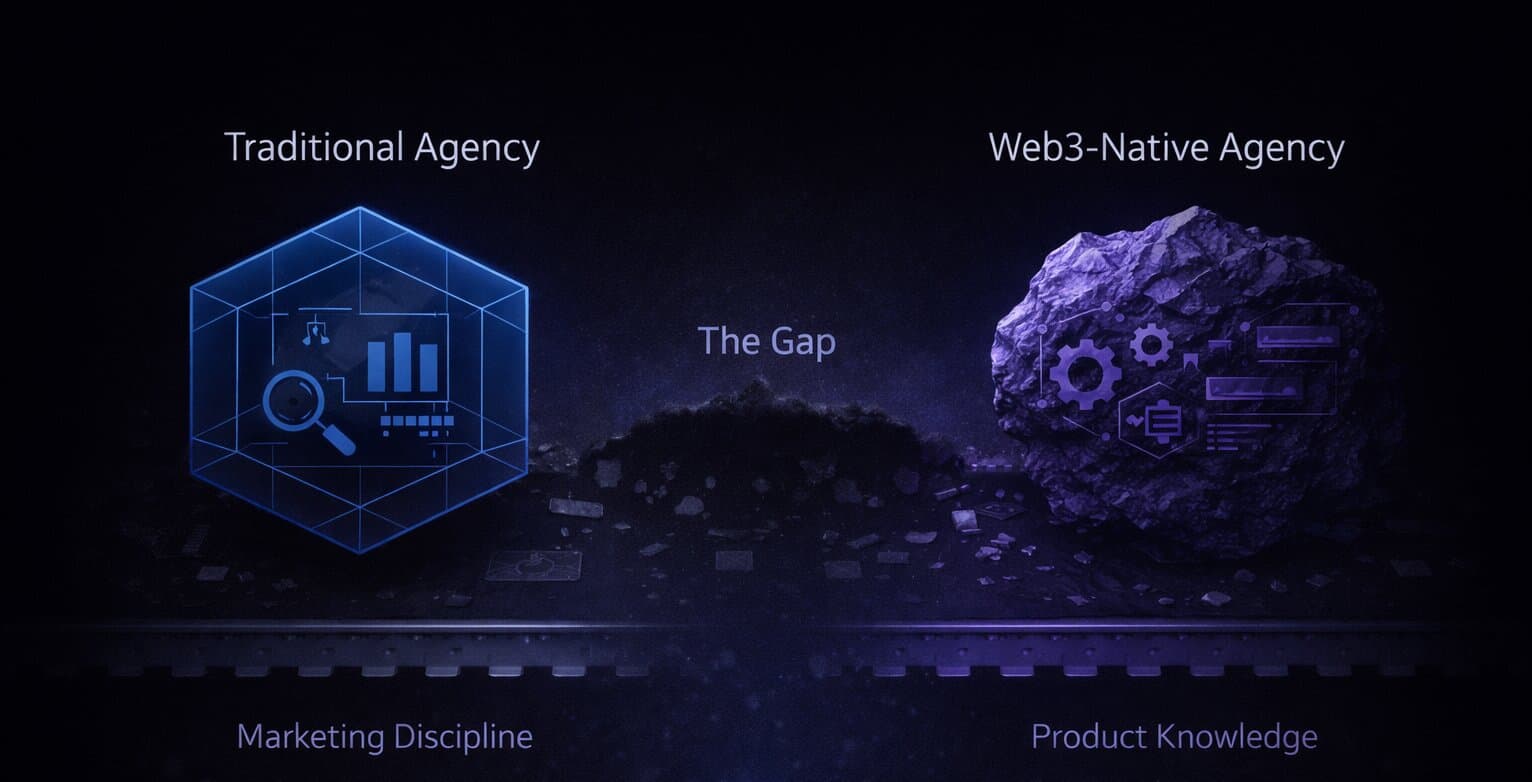
What's emerging, and what I think the market actually needs, is a different kind of operator. Someone who understands both the marketing discipline and the product deeply enough to bridge the gap. That means neither a marketer who's "crypto-curious" nor a crypto native who's picked up marketing language. Someone who can sit in a technical conversation about protocol design and then translate that into a positioning strategy that actually resonates with the right audience.
None of this is anti-agency. The point is that the knowledge asymmetry in this market is severe enough that the person setting the strategic direction needs to genuinely understand what they're marketing. Whether that's a founder who's learned marketing, an operator with deep domain experience, or an agency that's invested seriously in technical literacy, the principle is the same: the thinking has to come from someone who understands both sides.
When to outsource (and what to keep)
The agency model isn't always wrong. There are scenarios where it makes sense.
If you need specialists you can't hire full-time, paid media expertise, SEO technical work, content in languages your team doesn't speak, agencies provide access to skills that would be uneconomical to employ directly.
If you need to scale quickly, a product launch, a market entry, a rapid growth phase, agencies can ramp capacity faster than an internal hire process.
If your marketing needs are well-defined and execution-focused, ongoing content production at a consistent volume and quality, an agency can provide reliable output.
Where the model breaks down is at the strategic level. Strategy should be owned by someone who understands the product and the market deeply. An agency can contribute to strategy, but outsourcing your strategic thinking to a team that manages fifteen other clients simultaneously is a recipe for generic, undifferentiated marketing. The best outcomes I've seen come from internal strategic ownership with selective outsourcing for execution and specialised skills. The founder or marketing lead sets the direction. Specialists execute within that direction. Nobody's outsourcing the thinking.
That's a harder model to sell, because it requires the client to do more work and the agency to accept a narrower role. But it's the model that produces results. And in a market where most marketing spend generates noise rather than outcomes, results are what matter.