Content Marketing in Crypto Is Mostly Noise
The Web3 content landscape is full of explainers nobody reads, threads nobody remembers, and blog posts that exist to fill a calendar. It doesn't have to be this way.

Go to any Web3 project's blog right now. Pick one at random. I'll wait.
There's a reasonable chance you'll find some combination of: a "What is [project name]?" explainer, a "2024 Year in Review" post, a "Why We Built This" founder letter, and three or four announcement posts dressed up as articles. The blog was probably active for two months after launch, went quiet for four, then had a burst of activity around a funding round or partnership.
This is what passes for content marketing in most of the Web3 space. Most of it is content for content's sake rather than marketing: filing cabinet material that nobody reads, shares or returns to.
I don't say this to be harsh. I say it because I've been asked to fix this problem so many times that the pattern is unmistakable. And the fix is fairly simple: it requires treating content as a strategic function rather than a checkbox.
To be clear: content marketing works. In technical markets (fintech, B2B infrastructure, regulated financial services) it's one of the most effective trust-building mechanisms that exists. It works because it demonstrates competence rather than asserting it. A detailed, well-reasoned piece about a real problem does something an ad campaign can't: it shows the reader that you understand their world. That compounds over time in a way that paid visibility never does.
The problem in Web3 is that most projects treat content as output, things to publish, rather than infrastructure that serves a strategic purpose. The distinction matters enormously, and almost nobody makes it.
The visibility fallacy: why impressions aren't demand
There's a persistent belief in Web3 that visibility is marketing. Build it, shout about it, they'll come. Get impressions, followers and coverage. The assumption is that if enough people see your name, the rest takes care of itself.
This worked in the early days. When the market was speculative and attention was literally the asset being traded, visibility was enough. Being loud in 2017 was a viable growth strategy because the audience was there to speculate, and any project generating noise attracted speculators. Being seen was enough; you didn't need to convince anyone of utility.
That era is over, even if parts of the industry haven't caught up. As markets mature, visibility disconnects from demand. Trending posts don't drive adoption. High follower counts don't mean anyone's using your product. The vanity metrics feel like traction (big community numbers, impressive impression counts) but they obscure whether the content is actually doing anything. Whether it's building trust with the people who might genuinely use what you're building.
The shift that matters is from content-as-noise to content-as-infrastructure, and it has nothing to do with volume. And in Web3, most projects haven't made that shift yet.
The explainer trap: why "What is DeFi?" posts don't work
Every Web3 project publishes explainers. "What is yield farming?" "Understanding Layer 2 scaling." "A beginner's guide to NFTs." There's a gravitational pull toward this kind of content because it feels safe and useful. You're educating people. What's wrong with that?
Two things.
First, your audience probably doesn't need the explanation. If you're building a DeFi protocol, the people evaluating your product already understand DeFi. They don't need your version of "What is DeFi?" There are thousands of those already, written by publications with more authority than your project blog. You're competing for a keyword you can't win, targeting an audience that isn't yours.
Second, explainer content doesn't differentiate. Your "What is staking?" post reads almost identically to everyone else's "What is staking?" post. There's no insight, no opinion, no unique perspective from your team. It's commodity content. Search engines know it. Readers know it. The bounce rate on these posts is typically brutal.
The exception is when your project genuinely does something new and needs to explain it. If you've invented a novel consensus mechanism or a new approach to cross-chain communication, by all means explain it. But explain it specifically: what it does, how it works, why it matters. Just don't wrap it in a generic industry primer.
The content that actually performs targets the questions people are already asking but nobody's answering well. That means real search intent, specific problems, and knowledge gaps that exist because the topic is hard or niche enough that the major publications haven't covered it properly. That's where a project blog can win: not competing with CoinDesk on "What is DeFi?" but owning the specific queries that your actual users type into a search bar when they're evaluating solutions.
Why most Web3 blogs have horrific bounce rates
I audited a Web3 marketplace's content and found a 67% bounce rate across their blog. Two-thirds of visitors were leaving after viewing a single page. The content wasn't bad. It was well-written, technically accurate, and covered relevant topics. So why was nobody sticking around?
The content had no job. Each post existed independently, disconnected from every other post and from the product. There was no internal linking strategy, no content funnel, no logical progression from "here's an interesting topic" to "here's how we solve that problem" to "here's how to get started." Every post was a dead end.
Compare that to a content system where each piece has a defined role. Top-of-funnel content captures search traffic and builds awareness. Mid-funnel content addresses specific problems and positions the project as a solution. Bottom-of-funnel content drives action: signups, integrations, downloads. Each piece links to the next. The reader moves through a journey that feels natural because it was designed to be.
After restructuring that marketplace's content around this logic, same topics, same quality, just with strategic intent, engagement improved by 73% and conversions from content increased by 10% within a quarter. The architecture had been the problem all along.

The AI content problem: why readers can always tell
I need to address this because it's getting worse.
Since late 2023, the volume of AI-generated content in the Web3 space has exploded, and it is not only a crypto phenomenon. Graphite analysed 65,000 English-language URLs from Common Crawl and found that articles written predominantly by AI went from around 5% of the sample before ChatGPT launched to 50.3% by November 2024, the month machine-written articles overtook human ones. It has hovered around half ever since. What the same study also found is the part worth sitting with: of the pages actually ranking in search, 86% were human-written. Volume is not visibility.
I can spot it within a paragraph. The cadence is too even. The structure is too symmetrical. The vocabulary reaches for the same words every time: "landscape," "leverage," "navigate," "robust." Paragraphs all run to approximately the same length. Sections follow a predictable pattern: statement, elaboration, example, summary.

This content ranks poorly, converts nobody, and, worst of all, makes the brand look like it doesn't care enough to have a human write its own blog. I've seen projects run their entire content programme through AI and wonder why engagement is zero. The audience can tell. Maybe not consciously, but they can tell something feels off. It reads like brochure copy. It lacks the unevenness, the specific observations, the occasional rough edges that signal a human actually thought about this.
I use AI in my workflow. I'm not anti-AI. But I use it the way you'd use a research assistant: to accelerate the gathering phase, to catch inconsistencies, to handle mechanical tasks. The thinking, the editorial judgement, the voice? Those are mine. The moment you hand those over, you lose the thing that makes content worth reading.
Content as infrastructure: capturing the attention other channels create
This is where I think the conversation gets interesting, and where most Web3 projects miss the point entirely.
Content is more than blog posts. When it's working properly, content is the infrastructure that makes everything else in your marketing more effective.
Here's a pattern I've seen play out repeatedly: a founder does a podcast, or gets quoted in a trade publication, or does a panel at a conference. The audience hears something that resonates. They search the founder's name or the project name. They land on the website. And what they find either reinforces the credibility that the media appearance created, or it undermines it.
If they land on a blog full of generic explainers and stale announcements, the narrative dies right there. The initial impression was "this person knows what they're talking about." The website says "this project publishes content because someone told them they should."
If they land on thoughtful, opinionated content that demonstrates the same depth the founder showed in the interview, the trust compounds. The media appearance drove the search. The content captured it. The reader moves from casual interest to genuine engagement, because the website validated what they heard elsewhere.
This is content functioning as a capture layer for earned attention. It captures the awareness that other channels create and converts it into trust, rather than generating awareness by itself. Most Web3 projects don't think about content this way, which is why their PR efforts and founder visibility don't translate into downstream results. The content isn't there to catch what the PR generates.
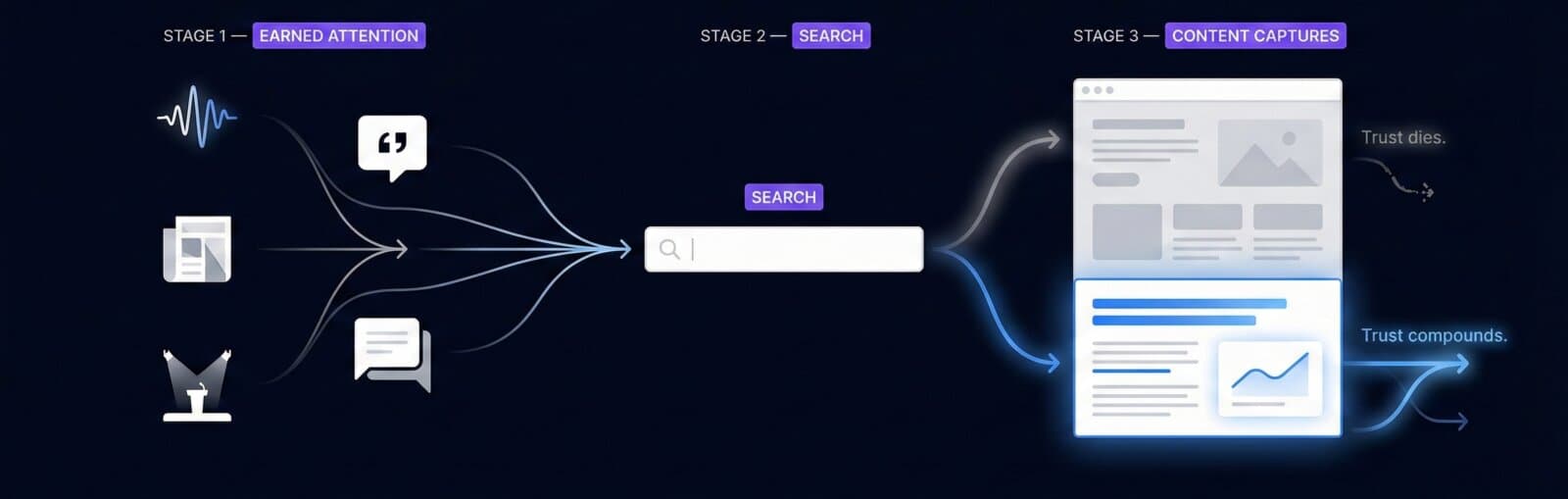
The same logic applies to search intent. When someone types a specific query into Google, something like "best custody solution for institutions" or "how to audit a DeFi protocol," and your content answers that question well, you've captured someone at the moment of highest intent. They were looking for something specific rather than browsing. Content that meets them there is conversion infrastructure, not just publishing.
What content with a job looks like
Effective Web3 content marketing starts with a question most projects never ask: what is this piece of content supposed to do?
The topic ("what should we cover?") comes later. First: what's the job? Is this piece supposed to capture search traffic for a specific keyword? Is it supposed to convert a reader who already understands the problem? Is it supposed to position the team's expertise on a specific topic? Is it supposed to give the sales team something to send prospects? Is it supposed to catch the traffic that a media placement will generate next week?
Each job demands a different approach. A search-optimised piece needs keyword research, competitive analysis, and a structure that serves both the reader and the algorithm. A conversion piece needs a clear articulation of the problem, an honest comparison of solutions, and a natural path to action. A thought leadership piece needs genuine insight, something the reader couldn't get elsewhere. A capture piece needs to reinforce a narrative the reader already encountered somewhere else.
When every piece has a job, the content calendar stops being a list of topics and becomes a strategic tool. You can see the gaps. You can measure whether each piece is doing what it's supposed to do. And you can stop producing content that exists only because "we need to publish something this week."
How to build editorial standards that hold
The projects I've seen succeed with content all share one trait: editorial standards that exist before the first draft is written.
This means a defined voice. "Professional and approachable" means nothing; I mean specific guidance: sentence length ranges, vocabulary boundaries, structural preferences, opinions the brand holds and is willing to express, opinions it won't touch. This gets documented, referenced before every piece, and refined as you learn what resonates.
It means a review process that's more than "does this have any typos?" Someone needs to read each piece and ask: would I share this? Does this say something that couldn't be found in ten other places? Is the opening strong enough to hold a reader past the first paragraph?
It means killing posts that aren't good enough. This is the hardest one. There's pressure to publish on schedule, and the sunk cost of a half-written piece makes it feel wasteful to bin it. But publishing mediocre content is actively harmful. Every weak post dilutes the signal from your strong ones. It trains your audience to stop paying attention.
I realise this sounds demanding. It is. Good content marketing is more expensive and slower than most projects expect. But the alternative is what most Web3 projects are currently doing: publishing into the void, measuring nothing, and concluding that content doesn't work.
Content works. It works as trust infrastructure in technical markets. It works as the capture layer for earned media and founder visibility. It works as search intent coverage for the queries that signal real buying behaviour. It works as the connective tissue between a first impression and a genuine relationship.
It just doesn't work the way most of this industry does it. And that gap, between content-as-output and content-as-infrastructure, is where the opportunity lives.