What gets a brand onto an AI shortlist?
What AI answers about crypto providers drew on, in four European retail markets and in institutional briefs, and where a marketing team could start.
Why does AI suggest a company whose own site doesn't rank on Google's first two pages for a buyer's question?
When auditing AI answers for a project, I found firms described as authorised when they weren't, and unclear claims about the services they could offer. Crypto had a benchmark for checking both in dated regulatory records: ESMA, the EU's markets regulator, publishes a register of authorised crypto-asset service providers (CASPs). Some claims were still hard to verify. Recommendations have no official answer, so I recorded which companies each platform suggested, to retail buyers in four European markets and to institutional buyers across twelve briefs.
False claims of authorisation actually turned out to be rare: of 160 answers about ten entities on ESMA's list of non-compliant firms, only one described an entity as authorised. I also looked at which companies the platforms suggested when buyers asked for a recommendation.
AI visibility is more than GEO/AEO and rankings; it's part of building your brand. Your reputation can influence whether buyers choose you and, as AI becomes another place people look for recommendations, whether they hear about you in the first place. That gives brand, product marketing, PR and SEO a shared job: making sure buyers can find clear reasons to choose your company, and ensuring that it is correctly described. An answer might name the right brand but give the wrong legal entity or permission. Test each AI platform separately: does it suggest your company for relevant buying questions, and does it describe your product and regulatory status accurately?
1of 10What I asked
What I asked
Retail buyers
The retail questions covered Germany, France, the Netherlands and Spain, in English and the local language, drawing on Google's autocomplete, suggested questions and related searches. The table shows one example from each group.
| Question group | Example prompt | Buyer's decision |
|---|---|---|
| Choosing a provider | "What is the best crypto exchange in Germany?" | Which providers should I consider? |
| Checking regulation | "Which crypto exchanges are regulated in Germany?" | Is the provider authorised? |
| Making a purchase | "How do I buy bitcoin by bank transfer in Germany?" | How can I complete the transaction? |
I also included questions asking for a licence under MiCA, the EU's crypto regulation, to see whether that changed the recommendations. Google's keyword data suggests relatively few people search using the term: in France, "plateforme crypto MiCA" had an estimated 170 searches a month, compared with 720 for "meilleure plateforme crypto". That doesn't mean buyers don't consider regulation important. They may look for a regulated provider without using the term MiCA.
Businesses and institutional buyers
I wrote twelve English-language briefs which specifically referenced Europe: three each for a fund, a treasury or family office, a wallet or neobank, and a firm looking to borrow. Institutional vocabulary barely appears in search data (about 10 searches a month for "institutional crypto custody" in each market), so the themes were inspired by queries from my employer's Search Console data (I work for a MiCA-authorised asset management company), Google's "People also ask" boxes and questions I had seen on LinkedIn. In my experience, institutions find providers through referrals and existing relationships, but AI is now another place to ask. The table shows three of the twelve.
| Service | Example prompt | Buyer's decision |
|---|---|---|
| Custody | "Which custodians in Europe offer segregated custody for a fund's bitcoin and ether holdings?" | Which custodians could meet the fund's requirements? |
| Portfolio management | "Which firms offer discretionary crypto portfolio management for corporate treasuries in the EU?" | Which firms could manage the treasury's holdings? |
| Embedded yield | "We're a European wallet app and want to add an earn or yield feature through a partner. Who provides that?" | Which suppliers could provide an integration? |
How the answers were collected
I asked both sets through the OpenAI, Perplexity and Gemini APIs, which I reached through OpenRouter, with search switched on, twice on 11 October and twice on 15 October 2026.
Collection details
Germany is used above to illustrate the groups. Versions were adapted for the other markets and their local buying context.
- Institutional briefs
- Twelve, in English, each asked twice on each date on each platform; 143 of the 144 first answers were usable.
- Named firms
- A separate test, on 7 October and 7 November 2026. I asked each platform, and OpenAI's model also without search, whether each of 90 firms drawn from ESMA's register is authorised under MiCA, twice each (89 were authorised on 7 October). I asked the same about ten entities on ESMA's list of non-compliant firms: 160 answers over the two dates.
- Models
- OpenAI's gpt-6-luna with its own web search, Perplexity Sonar, and Google's gemini-3.8-flash with Google Search grounding, all requested through OpenRouter. For OpenAI and Gemini, search was switched on and using it was left to the model: Gemini recorded no search and no source for 54 of its 176 answers to the retail questions on choosing a provider, checking regulation and making a purchase, and 26 of its 48 institutional first answers. Search is part of the Perplexity configuration I requested. The Perplexity requests were made and recorded as Sonar, and I did not independently verify the model or routing behind them.
- Reading the answers
- I coded samples of the answers myself and used them to check an AI model that listed the companies in every retail answer. I decided every institutional code myself.
- Location
- None was sent to the AI platforms. The Google results were targeted to each market.
- Google data
- DataForSEO. For each retail question, targeted to each market, the organic results on Google's first two pages (usually 18 or 19 listings; ads not counted), plus keyword volumes.
- Brand and link figures
- DataForSEO, November 2026, for the 40 companies named in most retail answers: Google Ads' monthly searches for the company's name in each market and the number of sites linking to its domain. Each is compared with shortlisting inside a market, on the companies named in five or more of that market's answers. Brand searches are used for 25 of the 40; the others have a name that is an ordinary word, are searched mainly for another product or have no Google figure.
- Cited pages
- For each market, the 30 pages cited most across the retail answers, leaving out providers' own sites, read on 18 November 2026. Of the 102 that could be read, 75 name two or more of thirteen exchanges; one page is among the 30 for both Germany and the Netherlands and is counted in each, so 74 are distinct pages. A company counts as named on a page if its name is in the visible text, which includes a passing mention or criticism. I call these 75 comparison pages, although they include news articles, tag and index pages, lists of licensed firms and one swap service's blog.
- Consumer apps
- Peec AI, for the Dutch observations of ChatGPT, Gemini and Google AI Overviews on 10 to 14 November.
- Register
- ESMA's register of authorised providers, downloaded on each collection day.
- Company lists
- One per market for the Google comparison, built from ESMA's register of 11 October using permissions relevant to buying crypto and each provider's recorded home or cross-border coverage: 263 companies for Germany, 184 for France, 185 for the Netherlands and 188 for Spain. Being on a list doesn't mean a firm serves retail buyers. A company counts once per question, platform and date if either repeat shortlisted it. Across the three platforms and both dates, the comparison covers 1,934 shortlistings of companies on these lists. Another 243 were of names outside them, such as wallet makers, banks, brokers and brands with no matching register entry, and being outside a list doesn't make a provider unauthorised. One Google pull failed on 15 October, so 49 shortlistings of listed companies and one other are left out.
- Scripts
- Collection and analysis in Python, written with Claude Code.
2of 10Shortlists and Google rankings
Most shortlistings involved companies whose own site did not rank
Companies whose websites appeared in Google's organic results for the same question were shortlisted more often. But far more companies were absent from the results I collected through DataForSEO, so they accounted for 84–89% of shortlistings across the platforms and dates.
Own site ranked (98 pairs)Did not rank (8,998 pairs)
Source: Oliver Carding, 2026. Method: Collection details.
Own site did not rankOwn site ranked
Source: Oliver Carding, 2026. Method: Collection details.
Across both dates, the share ran from 74% on how-to-buy questions and 79% on the unqualified "best" question to 91% on the regulation questions, which supplied most of the shortlistings.
A Google ranking may not be the reason a company gets suggested. Well-known providers may be more visible in both Google and AI answers, for reasons that go beyond the ranking itself. I look at brand recognition and shortlisting later in the article.
AI platforms can also search beyond the buyer's original question. Google says its Gemini API can generate several searches from one prompt. Asked for the best exchange, it might also search for trading fees and find pages that didn't appear in the Google results I collected for the original question.
A study published in August 2025 found that 8% of ChatGPT's inline citation URLs and 28.6% of Perplexity's cited URLs appeared in Google's top 10 for the same prompt. That study looked at the pages cited by AI, whereas I looked at the websites of the companies it recommended.
3of 10Product facts in recommendations
The product facts that appeared in recommendations
Bitvavo shows what a shortlisting without a ranking looked like. Its own site did not rank for any German focused questions on either date, yet OpenAI's API shortlisted it in all eight answers to the unqualified "best" question.
"If I had to pick one for a typical person in Germany buying and holding crypto, I'd start with Bitvavo—mainly because an independent Frankfurt School study found it had the lowest average total trading cost among nine German providers tested: 0.53% for a buy-and-immediate-sell round trip. […] Bitvavo's published fees for euro-market trades start at 0.15% maker / 0.25% taker, and its fee page lists SEPA bank transfers as free."
- frankfurt-school.deStudy announcement
- bitvavo.comFee page
- kraken.comFee schedule
- esma.europa.euConsumer warning
All eight answers discussed cost and regulation. Six gave Bitvavo's entry fees, and five cited a study by the Frankfurt School Blockchain Center and intas.tech. The study compared the cost of buying and selling crypto across nine providers and found Bitvavo had the lowest average cost.
Bitvavo wasn't the only provider publishing its fees. BSDEX had a fee page too, but OpenAI shortlisted it in just one of the eight answers. Bitvavo was also a better-known name in Germany. As I'll come on to, research has found that brands mentioned more often on other websites also tend to appear more often in AI answers.
Several things could help explain why Bitvavo appeared in those answers:
- A competitive price
- In the cost study five of the answers cited, it was the cheapest of nine.
- A price published clearly
- The fee was on a page the platform could cite, as a number, and Bitvavo's German fee page showed the same starting tier when I checked it on 21 November.
- A favourable evaluation elsewhere
- The study gave the platform a third party's measurement to quote.
- A well-known brand
- Bitvavo is a much bigger name in Germany than BSDEX, a German venue with an order book that appeared in one of the eight answers.
Whether there is a price advantage to claim is not marketing's to fix. If the product is dearer or narrower than a competitor's, clearer pages will make that easier to see.
4of 10Institutional briefs
On one institutional brief the platforms suggested different suppliers
The institutional briefs covered practical requirements such as custody arrangements and integrating a service. In one brief, a European wallet app wanted to add an earn feature through a partner. The platforms suggested different suppliers.
| Platform | Shortlisted Kiln | Shortlisted Yield.xyz |
|---|---|---|
| OpenAI API | 4 of 4 | 0 of 4 |
| Perplexity API | 0 of 4 | 4 of 4 |
| Gemini API | 4 of 4 | 0 of 4 |
Source: Oliver Carding, 2026. Method: Collection details.
OpenAI's answers all cited Kiln's own site. One cited its page for fintechs and wallets. Perplexity's answers cited Yield.xyz's profile in Circle's partner directory, which offered wallets and neobanks a way to "Launch a native 'Earn' feature" when I read it on 13 November. The profile is Yield.xyz's own listing, and Circle says a listing in its directory is not an endorsement. Gemini's answers listed 11 to 14 firms each, Kiln among them.
A custody brief shows what answers did with such pages. It asked which custodians in Europe offer segregated custody for a fund's bitcoin and ether, and Zodia Custody was shortlisted in all twelve first answers. All four of OpenAI's answers and three of Gemini's treated "segregated" as a term the fund had to pin down.
"'Segregated' can mean a dedicated on-chain wallet for the fund, legal separation from the custodian's own assets, or merely separate accounting records within an omnibus wallet. Ask each provider to confirm in the custody agreement that the fund's BTC and ETH will be held in fund-specific wallets […]"
- zodia-custody.comCustody policy
- komainu.comCustody page
- bitgo.comBitGo Europe GmbH's entity page
- copper.coQualified custody
- esma.europa.euMiCA, Article 75
Three of OpenAI's four answers cited Zodia's custody policy. An archived copy from 7 October said client assets were held in "segregated cold storage address wallets". One answer also cited BitGo Europe's custody agreement. All four advised the fund to confirm the wallet arrangement in its agreement. Perplexity's two answers on 11 October cited an announcement by the fund manager DWS naming Zodia Custody and Coinbase as custodians of the bitcoin and ether ETCs it launched.
Sygnum and AMINA, the firms shortlisted most across the twelve briefs, had their own site among the sources of over 70% of the answers that shortlisted them and listed any.
Perplexity also cited LinkedIn posts or articles in 13 of its 48 answers to the briefs. Two of its answers to the brief from a fund manager looking for a custodian pointed to Coinbase Institutional's post on segregated custody for EU clients.
The answers also passed on what a page said about its own limits. An OpenAI answer about yield for a neobank's customers said Tesseract's "own materials say the API's lending activity is not regulated under MiCA". The answer cited the lending page of Tesseract, my employer. An archived copy of the page from 3 October said the same.
5of 10What comparison pages said
What the cited comparison pages said about each brand
Perplexity's answers about France leaned on publishers' comparisons. They shortlisted Coinhouse in 34 of 40 and Paymium in 12, both French and authorised by the AMF, the French regulator. Of the pages the three platforms cited most, other than providers' own, 75 name two or more exchanges: Kraken, the company shortlisted most, is on 70 of them, Coinhouse on 18 of the 19 French ones and Paymium on 4.
Across the 40 companies the answers named most, the ones on more of a market's pages were shortlisted more often there, in all four markets. A company may be on these pages because it is already well known, and a listing was not enough on its own: Binance is on 65 of the 75, yet it was shortlisted in fewer than one answer in ten and named with a warning about as often.
In places, the pages and the answers described a brand the same way. Meilleurtaux's comparison calls Coinhouse "l'acteur français" (the French player), and an answer citing it offered Coinhouse to buyers who want a French platform. The line may have come from the page or from Coinhouse's own site.
Who appears on these pages is the publisher's decision, or its advertising partner's on the two German pages, and the comparisons Perplexity pointed to most say how the choice is made.
| Publisher | Says it selects or scores by | Commercial disclosure |
|---|---|---|
| Cryptoactu France | Eight weighted criteria out of 100, including MiCA status, fees, a French tax report, asset range and French support. | Its transparency page names OKX as official partner and says its OKX links can pay it commission. OKX is ranked first. |
| Meilleurtaux France | Compares fees and services under MiCA; no scoring. | Says it lists an offer only under a partnership contract. |
| Datawallet Spain | Six criteria, including licence checks, the cost of a real trade, asset coverage and Spanish relevance. | May earn commission on links; says partners have no influence on rankings. |
| Handelsblatt, WirtschaftsWoche (Handelsblatt Media Group) Germany | Providers available nationwide, chosen by search demand and market significance; details from providers' own sites and price lists. | "Anzeige": all content on the page is an advertising partner's offer. |
6of 10Authorisation and recommendation
Checking authorisation and recommending a provider are different tasks
Source: Oliver Carding, 2026. Method: Collection details.
Supporting detail
Four answers, from Perplexity and Gemini on 7 October, called a bank authorised five days before its permission started.
In the authorisation test, I asked about companies by name. I also asked the platforms which providers a buyer should consider.
Paymium was shortlisted in up to 13 of 16 answers per platform to the French regulation questions, but in none of the 24 answers to the unqualified "best" question. Its home page listed nine crypto-assets when I checked it in November. Whether that affected its chances of being suggested is unclear; plenty of licensed companies were suggested as the best choice.
Accuracy got harder to check for a product than for a firm. Asked for each firm's legal entity, one Perplexity answer said "Kraken Custody" was authorised and gave the entity as "Kraken / Ireland", from a third-party tracker. The register has no entry by that name, and a Kraken post links the product to its Irish entity, Payward Europe Solutions Limited.
7of 10Better-known companies
Companies shortlisted more often were usually better known
In Germany, Bitvavo's name is searched about 22,000 times a month in Google against about 6,600 for BSDEX. The same holds in France, for Coinhouse against Paymium, and most sharply in Spain: Bit2Me was shortlisted in 110 of 120 answers and Fazil Crypto in 3, and Bit2Me's name is searched about a hundred times as often.
A study of 10,000 US brands, published in November 2026, found that mentions on other sites went with mentions in AI answers, and that the relationship weakened, but held, among brands with similar search demand. The study counted any mention of a brand in answers to prompts that did not name it; I counted recommendations.
Beyond the pairs, I compared the 40 companies the answers named most, inside each market. Among the 25 whose name is a usable measure of demand, the companies searched for more by name were shortlisted more often, in all four markets. The result depends on which names count: add those that are ordinary words, such as Gemini, or searched mainly for something else, such as Revolut, and the relationship weakens in three markets and disappears in France.
The figures behind this
Brand searchesLinking sites
The figures show how closely each measure tracked the number of answers shortlisting a company. A figure near 1 means companies higher on one measure tended to be higher on the other. A figure near −1 means they tended to be lower; a figure near 0 shows little consistent relationship.
The chart covers 25 of the 40 companies named most often, with 13 or 14 companies in each market. The answers came from retail questions asked through the OpenAI, Perplexity and Gemini APIs on 11 and 15 October 2026. Brand-search figures from Google Ads and the number of sites linking to each company's domain, from DataForSEO, were collected in November. These are small groups, so the results are uncertain.
Source: Oliver Carding, 2026. Method: Collection details.
With the other 14 companies that have a search figure, the brand figures are 0.36 in Germany, −0.08 in France, 0.25 in the Netherlands and 0.26 in Spain. Google gives no figure for SwissBorg's name, so it is left out.
17 of the 36 sites that gave a clear answer had an llms.txt file in November.
Links remain part of how Google ranks pages. In my sample, the number of sites linking to each company's domain showed no consistent relationship with how often it was shortlisted by AI. Neither did having an llms.txt file (a file some sites publish to describe themselves to AI systems).
Better-known companies may attract both publisher coverage and AI recommendations, and this study cannot separate those effects.
8of 10Platform and question
Both the platform and the question changed which companies appeared
Source: Oliver Carding, 2026. Method: Collection details.
The platforms work differently. Their lists differ in length: an OpenAI answer put forward 4.2 providers on average, a Perplexity answer 7.5 and a Gemini answer 8.6.
Their sources differ too. Every OpenAI answer about France had the French regulator's site among its sources, whether or not it shortlisted Coinhouse. Perplexity cited comparison pages. Gemini's API recorded no search and no source for six of its eight unqualified "best" answers about France, so those probably drew on what the model already knew.
Forums, social and video sites were close to absent from the answers to the questions on choosing a provider, checking regulation and making a purchase: of the 474 that listed sources, 24 cited one, and none cited Trustpilot or Wikipedia. That is a long way from the league tables DataForSEO published in October 2026, which pool every kind of question asked in US English and put YouTube first in Google's AI Overviews and Wikipedia first in ChatGPT.
Across 88 pairs of answers per platform to the same question on the same day, OpenAI's answers shared 47% of the providers suggested in either answer. The figures were 71% for Perplexity and 58% for Gemini. A single answer gives only a snapshot of which companies a platform might suggest.
The question mattered too. Across the three platforms' German-language answers, Bitpanda was named in 4 of 12 answers to "Which is best?" and all 12 answers to "Which are regulated?" OKX was named in none of the first group and 9 of the second. The regulation answers also listed more firms.
9of 10A cited comparison
A company's page can be cited without the company being named
I also tested the consumer versions of ChatGPT and Gemini, along with Google AI Overviews, using questions about the Netherlands, tracked with Peec AI, an AI visibility tracker. On 10 November, BTC Direct's comparison of exchanges appeared among the sources of 12 of 108 answers. Those answers named other providers, but not BTC Direct.
The same pattern appeared on each of the next four days: none of the answers citing the comparison named BTC Direct. The company was named in other answers, including 21 of the 108 on 10 November.
1BTC Direct's article appears as a source.
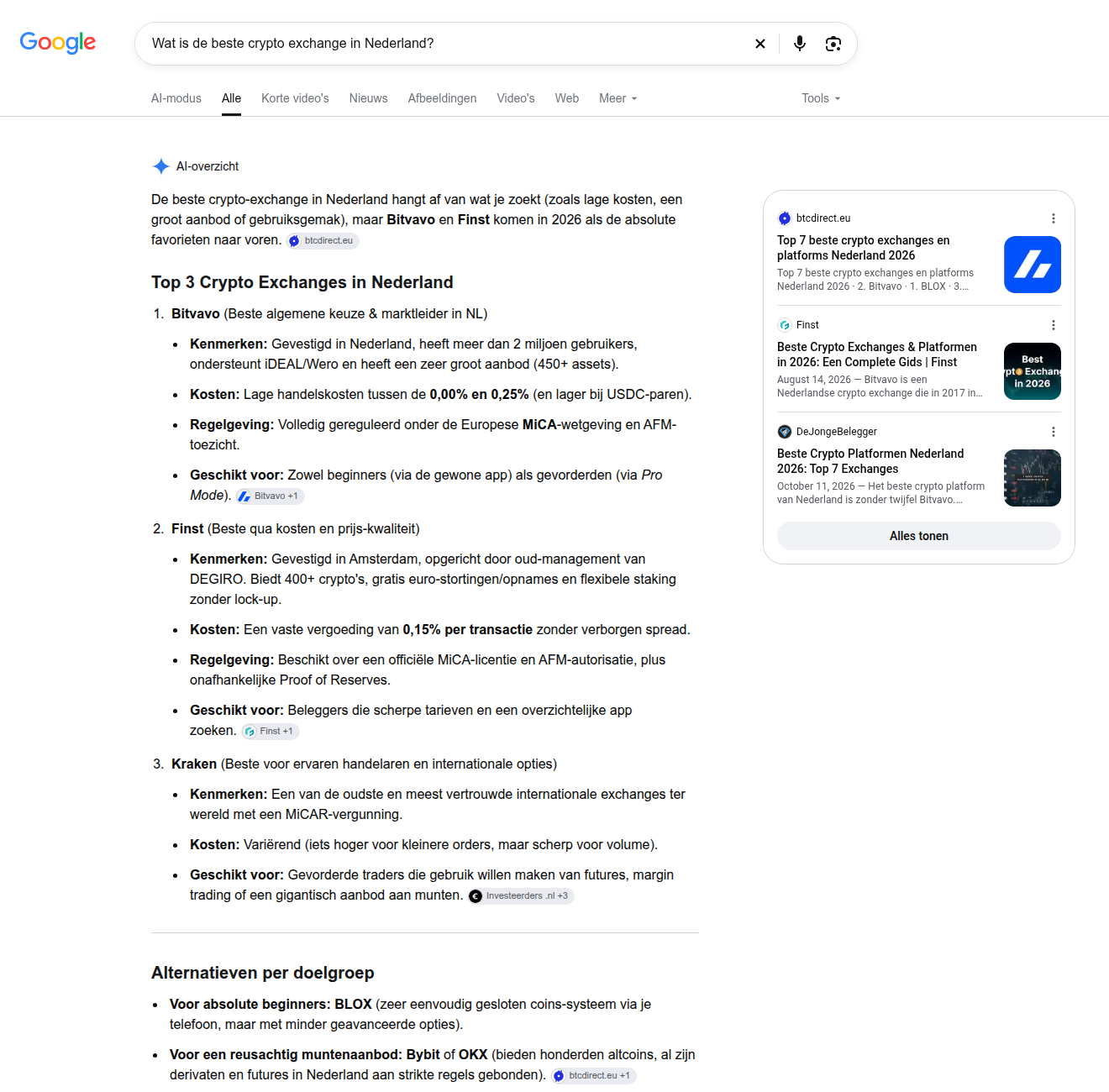
2Other providers named in the answer.
Show the larger capture
In October, I also asked questions through the platforms' APIs. Perplexity cited BTC Direct's comparison in 15 of its 48 answers about the Netherlands and shortlisted BTC Direct in none of them.
Perplexity cited Finst's comparison, in Dutch or English, in 19 answers and shortlisted Finst in 17 of them. It also shortlisted Finst in 12 of the 29 answers that did not cite the page. When I read the comparison on 18 November, Finst put itself first.
If I were reviewing an owned comparison page, I'd start with what it is there to do and make clear who publishes it and any commercial relationships it contains.
10of 10Recommendations for marketing teams
Recommendations for marketing teams
These are the pieces of work I would start with on AI visibility, informed by the findings. The study did not test whether they increase shortlisting, leads or revenue. I would begin with work that also helps buyers and the marketing you already do, then judge further AI-specific spending against your audience and business results. Traffic from AI tools is one possible benefit; buyers may also act on answers without clicking through.
Cost a representative purchase
Six of OpenAI's eight answers to the "best" question about Germany gave buyers Bitvavo's entry fees, and five cited a comparative cost test. A useful output is an accurate, dated comparison of the full cost of one representative purchase: trading fee, spread, paying in and withdrawing, with the countries served and any restrictions. Whether it changes what the platforms suggest is untested.
Read the comparisons the answers cite
Companies named on more of the cited comparison pages were shortlisted more often in all four markets. I'd list the publications appearing in answers to your buyers' questions, then check their selection criteria and what they say about your company. Does your product meet those criteria, and is the information accurate?
Check commercial relationships too. Cryptoactu ranked OKX first and disclosed that its OKX links can pay it commission. The records don't show that the placement produced a recommendation.
For each publication, you could prepare corrections to request and evidence to offer. Coverage alone is no guarantee: Binance appeared on 65 of the 75 pages but was shortlisted in 45 of 528 answers.
Make each institutional document answer its part of the brief
The wallet answers cited Kiln's website and Yield.xyz's own profile in a partner's directory. In the custody answers, the sources included Zodia's policy and a fund manager's announcement naming its custodians.
I'd take a requirement your product meets and check how it is described across your website, technical documentation and partner profiles. Where a claim depends on the customer agreement, make sure the public wording is supported by it. Whether these changes would affect recommendations remains untested.
Trace how your regulatory position is described
Answers drew on third-party trackers as well as the register, as the Kraken Custody answer above shows. I would trace how each offering's name, contracting entity, authorisation date, services and limits appear on your own pages and on the third-party pages that describe you. On the product page, state them in the register's wording and link to the register, or to your own entry where your national regulator publishes one.
Measure by platform, market and question
Lists changed between askings and between platforms, and a platform could cite a company's page without suggesting the company. I would choose questions from real buying decisions, ask each several times on each platform and in each market, and record citations, mentions and recommendations separately, noting which recommendations are conditional. The output is a rate per question and platform, with the list length beside it, read against business results.
The product has to fit the buyer. A register entry alone won't tell you whether a provider serves that customer or offers the service they need. This work involves product marketing, brand, PR, partnerships and SEO; the study did not establish which factors led a platform to suggest a company.
Start by checking that your key pages can be accessed and indexed, and that prices, legal entities and service limits are in the page text. Google says a page must be indexed and eligible to be shown with a snippet in Search to appear as a supporting link in its AI features. Other platforms may work differently.
The methodology and all results.
A short summary.
This is an independent study, carried out and funded outside my employment at Tesseract Investment Oy. The views and recommendations are my own. Tesseract Investment Oy is on ESMA's register. It was not excluded from the study and was shortlisted in 17 of the 143 institutional first answers. I use it as one example in the institutional section, where the other firms named compete with it.